
Getting Started
What Is a Crypto Wallet? Hot vs Cold vs Self-Custody
Wallets hold keys, not coins. Hot vs cold vs self-custody, explained.
A crypto wallet doesn't really "hold" your coins — it holds the keys that control them on the blockchain. Understanding wallets is the foundation of crypto security.
The one idea that matters
"Not your keys, not your coins." Whoever controls the private key controls the funds. That's why how you store keys matters more than almost anything else.
Wallet types
| Type | What it is | Best for |
|---|---|---|
| Exchange (custodial) | The exchange holds keys for you | Convenience, active trading |
| Hot wallet (self-custody) | App/browser wallet, online | Small, everyday amounts |
| Cold wallet (hardware) | Offline device | Long-term savings |
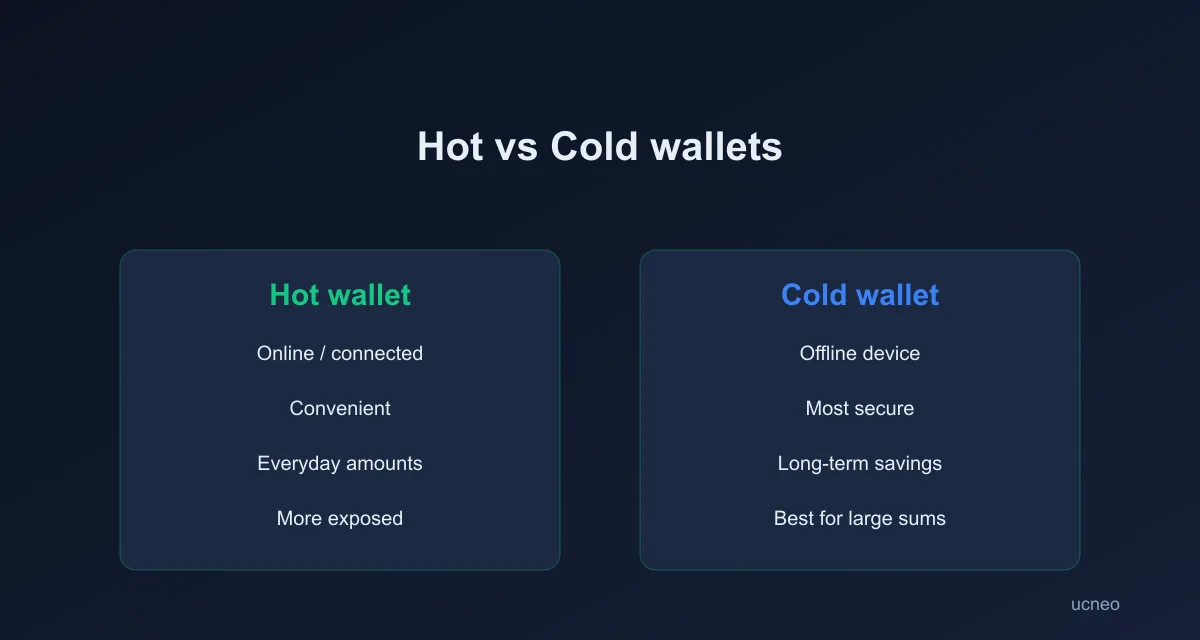
Hot vs cold, simply
- Hot wallets are connected to the internet — convenient but more exposed to hacks and phishing.
- Cold wallets stay offline — the safest option for larger, long-term holdings.
Security basics
- Back up your recovery phrase offline (on paper/metal); never type it into any website.
- Only download wallet apps from official sources — fake wallets are a common scam. See how to avoid crypto scams.
- A sensible path: start on a reputable exchange, then move to self-custody as your holdings grow. New? See our registration guide.
Storing a recovery phrase: do / don't
| Do | Don't |
|---|---|
| Write it by hand on paper or metal | Screenshot it or photograph it |
| Keep 2 copies in separate secure places | Store it in email, cloud notes, or a password manager you sync |
| Keep it secret from everyone | Type it into any website ("wallet validation" = scam) |
Moving from exchange to self-custody, 5 steps
- Download the wallet only from the official source (check the developer name).
- Create the wallet and back up the recovery phrase offline; verify the backup.
- Send a small test amount from the exchange (network must match).
- Confirm arrival, then send a little back — prove you control both directions.
- Move larger amounts gradually.
Buying a hardware wallet safely
Buy new, directly from the manufacturer or an authorized reseller — never second-hand or from random marketplace listings (devices can be tampered with). A genuine device will never ask you to enter your phrase on a website or computer.
When keeping funds on an exchange is fine
For small, actively traded balances, a reputable exchange with strict 2FA is a reasonable trade-off. The rule of thumb: the larger and the longer-held the funds, the stronger the case for self-custody.
FAQ
Do I need a wallet to start? Not immediately — a verified exchange account works to begin. Self-custody matters more as you hold more. Which is safest? A hardware (cold) wallet with an offline backup of your recovery phrase.
Educational content only. Not financial advice.