
Getting Started
What Is Ethereum (ETH)? A Beginner's Guide
Ethereum explained simply: smart contracts, gas, value and risks.
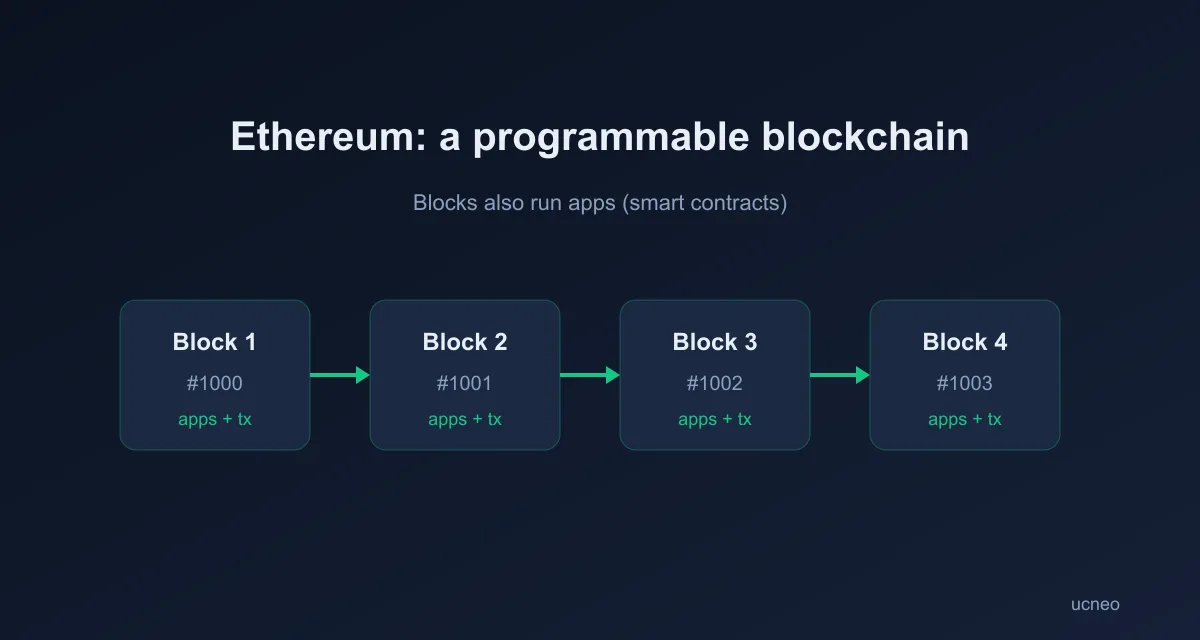
Ethereum (ETH) is the second-largest cryptocurrency after Bitcoin — but it is more than a coin. It is a programmable blockchain that lets developers build apps, tokens, and financial tools that run without a central operator. This guide explains it simply.
Bitcoin vs Ethereum in one line
- Bitcoin was designed mainly as digital money / "digital gold."
- Ethereum was designed as a platform for programs called smart contracts. Its coin, ETH, pays for using the network ("gas").
Key concepts
| Term | Meaning |
|---|---|
| Smart contract | Code that runs automatically on the blockchain |
| Gas fee | The cost (paid in ETH) to run a transaction |
| Token | An asset built on Ethereum (many stablecoins live here) |
| dApp | A decentralized app (DeFi, NFTs, games) |
Why people value ETH
- It powers a huge ecosystem of apps, tokens, and DeFi.
- ETH is used to pay network fees, so demand is tied to usage.
- Like all crypto, its price is volatile and driven by supply and demand.
How to get ETH
Buy a small amount on a reputable exchange after verification, then hold it on the exchange or move it to a wallet you control. New here? See our exchange guides and how to buy USDT (the steps are similar).
Key risks
- Volatility and market swings.
- Gas fees can spike when the network is busy.
- Smart-contract risk: buggy or malicious contracts can lose funds — stick to well-known apps.
- Scams: ignore "send ETH, get more back" offers.
Gas: the network's fuel
Every Ethereum transaction pays gas in ETH — like fuel for a car. When the network is busy (a hyped mint, a volatile day), gas spikes; when quiet, it's cheap. That's why the same transfer can cost very different amounts at different times.
Layer 2: the express lanes
Because mainnet gas can get expensive, Layer 2 networks process transactions cheaply "on top of" Ethereum and settle back to it. For a beginner the practical takeaway: when an exchange offers a cheaper withdrawal network for an Ethereum asset, it's often an L2 — and the "network must match the destination" rule still applies.
Staking in one paragraph
Ethereum is secured by validators who lock up ETH (staking) and earn yield. Exchange "earn/staking" products essentially delegate your ETH into this system — rates float and risks remain; it is not a bank deposit.
ETH vs BTC at a glance
| Bitcoin | Ethereum | |
|---|---|---|
| Focus | Digital money / store of value | App platform (smart contracts) |
| Supply | Hard cap 21M | No fixed cap (dynamic) |
| Network fee | Relatively simple | Gas, varies with congestion |
| Beginner learning curve | Gentler | More new concepts |
FAQ
Is Ethereum the same as Bitcoin? No — Bitcoin is money-focused; Ethereum is a programmable platform. Can I buy less than 1 ETH? Yes, a small fraction is fine. What is a stablecoin's link to Ethereum? Many stablecoins (like USDT) are issued as tokens on Ethereum and other chains. See what is USDT.
Educational content only. Not financial advice.