
Trading Tutorials
How to Buy USDT (Tether): A Beginner's Guide
What USDT is and how to buy it safely, step by step.
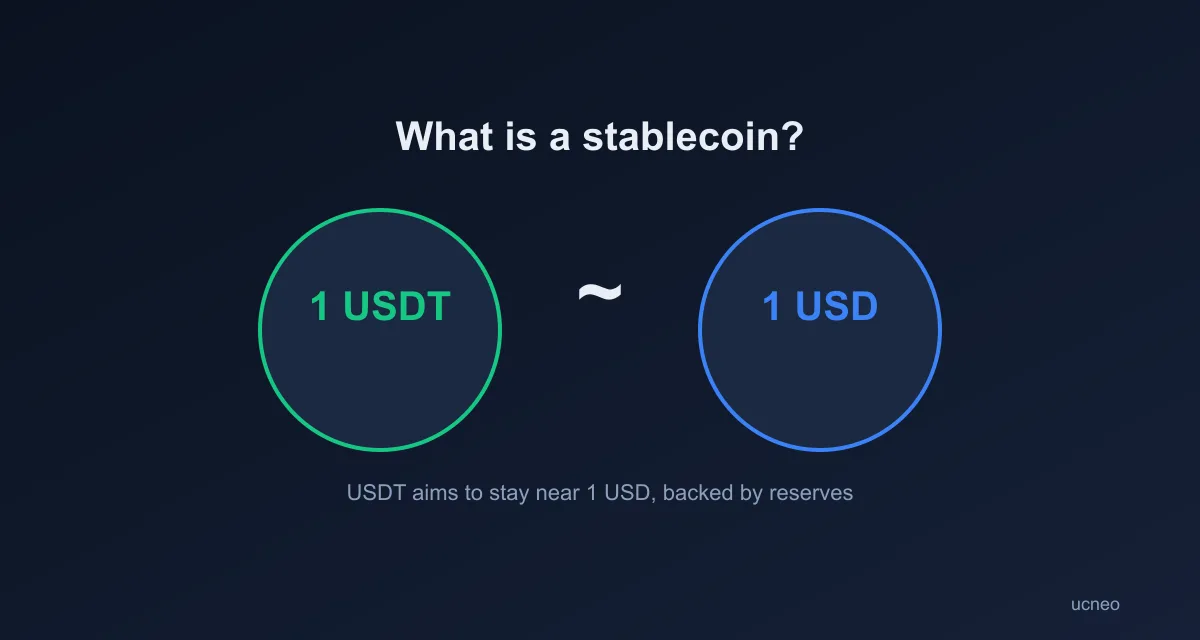
USDT (Tether) is a stablecoin designed to track the value of the US dollar, so 1 USDT aims to be worth about 1 USD. Beginners use USDT to move in and out of volatile coins without converting back to local currency each time.
Why people use USDT
- A "parking spot" during volatile markets
- Fast, low-cost transfers between exchanges and wallets
- The most common trading pair — many coins are priced in USDT
Things to understand first
- A stablecoin's peg depends on the issuer's reserves; it is not risk-free.
- Always send USDT on the correct network (e.g. the network your exchange specifies). Sending on the wrong network can cause permanent loss.
How to buy USDT, step by step
- Register and verify on a reputable exchange. New here? Follow our exchange registration guide.
- Deposit funds — via crypto, or fiat/P2P where supported.
- Open Buy Crypto or the spot market and select a USDT pair (e.g. USDT/your currency).
- Enter the amount, review the fee, and confirm.
- For larger amounts, consider moving USDT to a wallet you control.
Networks: don't lose your money here
| If the receiver expects... | Send on... |
|---|---|
| An exchange deposit | The exact network shown on the deposit page |
| A wallet you own | A network that wallet supports |
When unsure, send a small test amount first.
Safety tips
- Double-check the network before every transfer.
- Beware "double your USDT" or "send 1 get 2" schemes — they are scams.
- Only risk money you can afford to lose.
How USDT stays near $1 (and when it hasn't)
The issuer claims each USDT is backed by reserves and can be redeemed for dollars — that arbitrage keeps the market price near $1. In stressed moments, USDT has briefly traded a little off its peg before recovering. The takeaway isn't panic; it's sizing: a stablecoin is a tool for moving value, not a place to park your life savings.
USDT vs USDC, quickly
| USDT | USDC | |
|---|---|---|
| Scale | Largest, deepest pairs | Second-largest |
| Reserve reporting | Periodic attestations | Generally more granular |
| Where it shines | Asia liquidity, most pairs | US/regulated venues |
For beginners: use whichever your exchange and trading pairs support best; larger holders often split between both.
Make the test-transfer a reflex
Before any first-time route (new exchange, new wallet, new network), send a small amount, confirm arrival, then send the rest. The habit costs cents and prevents the classic total-loss mistake — see also what is a crypto wallet.
How much to start with
The right first amount is one where losing it entirely would change nothing about your month. For most beginners that is a small, specific number decided in advance — not "whatever is left over".
The reason is not caution for its own sake. A first purchase has a job: to teach you the mechanics of buying, holding, moving and selling, including where the interface confuses you and how long each step takes. That lesson costs the same whether you buy a little or a lot, so there is no reason to pay for it with a large position.
Start small, complete the full loop — buy, transfer out, transfer back, sell — and only then decide whether to size up. People who skip the loop discover the withdrawal step for the first time under pressure, which is exactly when mistakes are most expensive.
Common beginner mistakes
Choosing the network by fee. The cheapest network is not the correct one; the correct one is what the destination supports. This single mistake accounts for more permanently lost funds than any other on this list.
Buying on an unfamiliar route because the rate looked better. A slightly better quote from a stranger, an off-platform deal, or an unofficial "agent" is the shape of most crypto scams.
Assuming all stablecoins are the same. They differ in issuer, reserve composition and disclosure practices. Treat that as a real difference rather than branding.
Skipping the test transfer. Covered elsewhere on this site, and worth repeating: it converts an irreversible mistake into a small one.
Confusing "no fee" with "no cost". A zero-fee purchase route usually recovers its margin in the spread — see the four layers of what you actually pay.
Where to keep USDT after you buy it
Three options, with different trade-offs.
On the exchange. Simplest, and reasonable for funds you intend to use within days or weeks. You are trusting the platform, which is a real risk that no review can price for you.
In a self-custody wallet. You hold the keys, so no platform can freeze or lose your balance. In exchange you take full responsibility for the recovery phrase, and there is no support desk. Read what a crypto wallet actually is before moving anything meaningful.
Split. Working balance on the platform, longer-term balance in self-custody. This is what most experienced holders converge on, and it is a sensible default rather than a clever strategy.
When USDT is not the right choice
USDT is a tool for holding a dollar-denominated balance inside crypto rails. It is not a savings product and it does not pay you anything by itself.
If you want to hold dollars and you have access to a normal bank account, a bank account is simpler and better protected. If you are being offered a yield on USDT, the yield is coming from somewhere — usually lending or a strategy with its own failure modes — and "stable" refers to the price target, not to the safety of whatever is generating the return. And if your goal is exposure to crypto price movement, a stablecoin gives you none by design; that is what buying Bitcoin or another asset is for.
FAQ
Is USDT safe? It is widely used but not risk-free; its value depends on the issuer's reserves. USDT or USDC? Both are large dollar stablecoins; pick what your exchange supports best. Why did my transfer not arrive? Often a wrong-network mistake — always match the network.
Educational content only. Not financial advice.