
Exchange Guides
OKX Fees Explained (2026): Maker, Taker, Deposits & Withdrawals
How OKX charges trading, deposit and withdrawal fees — and how to pay less.
Disclosure: This guide contains a referral link to OKX. If you register through it, ucneo may earn a commission at no extra cost to you, and you may qualify for trading-fee rebates. Educational content only — not financial advice. Crypto trading carries risk, including the possible loss of your capital.
Understanding fees is one of the easiest ways to keep more of your money. This guide explains how OKX charges fees — trading, deposits, and withdrawals — in plain English, so there are no surprises.
Trading fees: maker vs taker
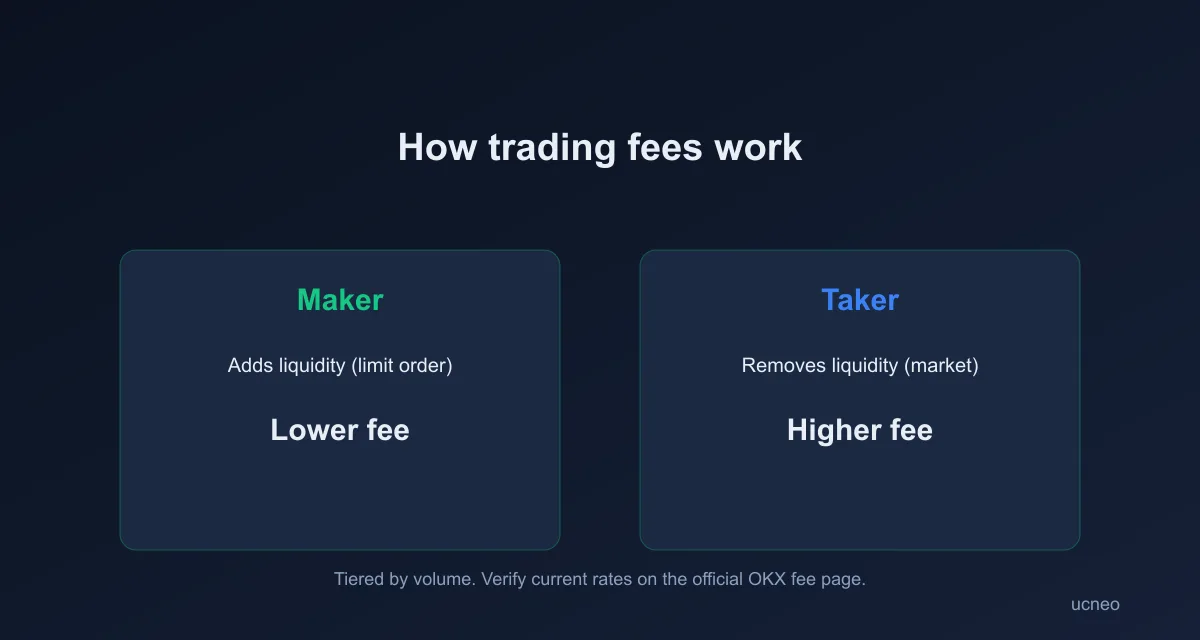
OKX (like most exchanges) uses a maker/taker model:
- Maker — you add liquidity by placing an order that waits on the order book (e.g. a limit order). Makers usually pay a lower fee.
- Taker — you remove liquidity by matching an existing order instantly (e.g. a market order). Takers usually pay a higher fee.
Fees are tiered by volume and by whether you hold the exchange's token — higher tiers pay less. Because exact percentages change, always confirm the current numbers on the official OKX fee page.
How to pay less in trading fees
| Tactic | Why it helps |
|---|---|
| Use limit orders when you can | You become a maker (lower fee) |
| Register via a referral link | You may get fee rebates — register here |
| Increase volume tier over time | Higher tiers = lower rates |
| Avoid over-trading | The cheapest fee is the trade you don't need |
Deposit fees
- Crypto deposits: OKX generally does not charge a deposit fee, but the blockchain network charges a miner/gas fee, and you pay that.
- Fiat / P2P: P2P is often low-cost or free on OKX's side; your bank or e-wallet may have its own charges. See how to deposit VND via P2P.
Withdrawal fees
When you withdraw crypto, OKX charges a network withdrawal fee that depends on the coin and network you choose. Tips:
- Pick a cheaper network when the destination supports it (fees vary a lot by network).
- Withdraw in larger, less frequent amounts to save on flat fees.
- Always send a small test amount first for large withdrawals. See our withdrawal guide.
Hidden costs to watch
- Spread on "instant buy" / express features can be higher than spot trading.
- Funding rates on perpetual futures (a recurring cost, not a one-off fee).
- Wrong-network transfers — not a fee, but a way to lose funds permanently.
The four layers of what you actually pay
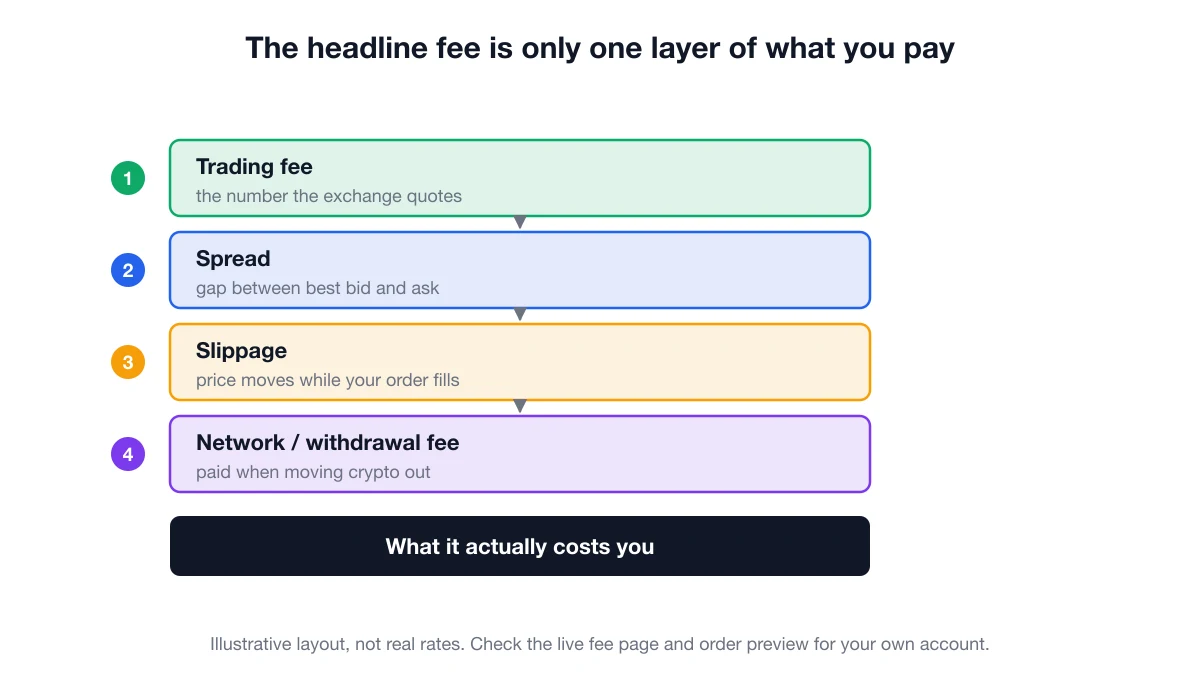
The maker/taker number is the only cost most beginners look at, and it is usually the smallest one. There are four layers:
- Trading fee — the percentage the exchange quotes for your tier.
- Spread — the gap between the best buy and best sell price. You cross it every time you use a market order.
- Slippage — on a thin pair or a large order, your order fills at progressively worse prices as it eats the book.
- Network fee — paid when you move crypto off the platform, and set by the blockchain, not the exchange.
Layers 2 and 3 do not appear on any fee page. They show up as the difference between the price you saw and the price you got. On major pairs like BTC/USDT they are usually small; on a low-liquidity pair they can dwarf the trading fee entirely.
Where to check your own rate (and why we do not print numbers)
We deliberately avoid quoting specific percentages. Fee schedules change, they differ by account tier and region, and a number that was right last quarter is worse than no number at all because it looks authoritative.
Check two places instead: the official OKX fee page while logged in, which shows the tier your account is actually on, and the order preview screen before you confirm. The preview is the one that matters, because it reflects your tier, the pair, and the order type together. Treat any article — including this one — that states a firm rate as out of date by default.
A worked example (invented numbers)
These figures are made up to show the arithmetic. They are not OKX's rates.
Say you buy $1,000 of an asset with a market order. Suppose your taker fee is 0.10%, the spread costs you another 0.05%, and slippage adds 0.03% because the pair is not especially deep. Later you withdraw to a wallet and the network fee happens to be $2.
- Trading fee: $1.00
- Spread: $0.50
- Slippage: $0.30
- Network fee: $2.00
- Total: $3.80, of which the "fee" you looked up was $1.00.
The lesson is not that the numbers are large. It is that the headline rate accounted for about a quarter of the real cost. Run this arithmetic once with your own order preview and you will never again pick a platform on the advertised rate alone.
Funding rate: a cost that only exists in derivatives
If you hold a perpetual futures position, you also pay or receive a funding rate, typically settled at fixed intervals. It is not a fee charged by the exchange to you; it is a payment between long and short holders that keeps the perpetual price tethered to spot.
The practical point for a beginner: a position that looks flat can still be bleeding, or quietly accruing, purely through funding. This is one of several reasons futures are a different instrument rather than "spot with more buttons", and it does not apply at all if you only trade spot.
Fee tiers and rebates, honestly
Exchanges use volume-based tiers: trade more in a rolling window, pay a lower rate. Holding the platform token can also move you down the table. Referral links, including ours, may qualify you for a rebate on part of the trading fee.
Two honest caveats. First, tier thresholds are far above what a beginner will trade, so in practice you will sit in the entry tier for a long time. Second, a rebate is a small discount on an activity whose main cost is usually how often you trade, not the rate. Trading twice as much to reach a cheaper tier is a losing trade. If you want to reduce fees, the highest-leverage change is almost always using limit orders where appropriate and trading less often — not switching platforms. Our OKX review and OKX vs Binance both treat cost as one factor among six, for the same reason.
FAQ
Are OKX fees high? They are competitive versus beginner "buy crypto" apps; verify current rates officially. Do rebates really lower my fees? Yes — as a referred user you may receive a rebate on part of your trading fees. Is there a fee to open an account? No; you only pay when you transact. See our registration guide.
Educational content only. Not financial advice. Verify current fees on official OKX pages. Last updated: July 2026.