
Exchange Guides
OKX vs Binance: Which Crypto Exchange Is Better in 2026?
A side-by-side comparison to help you choose between two of the biggest exchanges.
Disclosure: This guide contains a referral link to OKX. If you register through it, ucneo may earn a commission at no extra cost to you, and you may qualify for trading-fee rebates. Educational content only — not financial advice. Crypto trading carries risk, including the possible loss of your capital.
OKX and Binance are two of the largest crypto exchanges in the world. Both are capable and widely used — the "better" choice usually comes down to your country and what you actually plan to do. Here is a practical, side-by-side comparison for beginners.
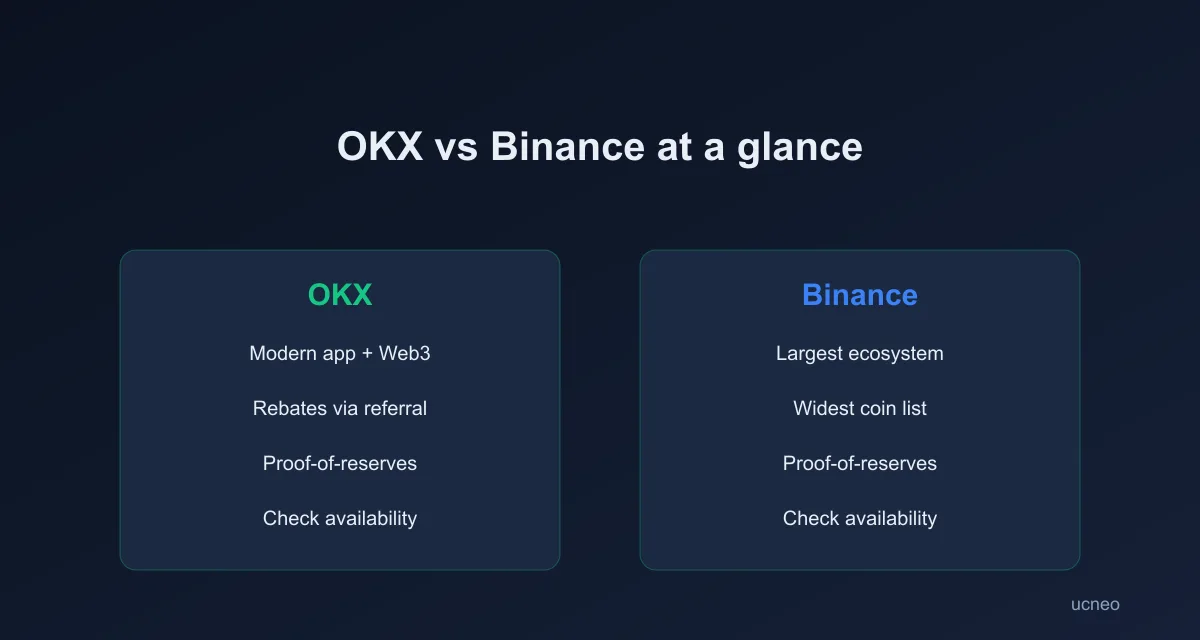
Head-to-head
| Factor | OKX | Binance |
|---|---|---|
| Fees | Competitive tiered maker/taker | Competitive tiered maker/taker |
| Products | Spot, futures, Web3 wallet, earn | Spot, futures, huge ecosystem, earn |
| Coin selection | Broad | Very broad |
| Security | Proof-of-reserves, 2FA, allowlist | Proof-of-reserves, 2FA, allowlist |
| Mobile app | Highly rated | Highly rated |
| Availability | 100+ countries, some restricted | 100+ countries, some restricted |
(Always confirm current fees on each platform's official fee page — they change.)
When OKX may suit you better
- You want a clean, modern app with a strong integrated Web3 wallet.
- A referral fee rebate matters to you. Register on OKX.
- OKX is the platform available and compliant in your country.
When Binance may suit you better
- You want the widest possible coin selection and ecosystem products.
- Binance is the one available and licensed where you live.
How to actually decide (3 questions)
- Is it available where I live? An exchange you cannot legally use is not an option — check first.
- What will I really use? Compare current fees for those specific products, not headline rates.
- Do I trust the security and support? Prefer the platform with protections and a track record you are comfortable with.
There is no universal winner. For many beginners the honest answer is: "the reputable exchange that is available and licensed where I live." If that is OKX, start with our registration guide; either way, read a full OKX review first.
Factor by factor, one level deeper
Fees. Both run competitive tiered maker/taker schedules; your real-world difference depends on volume tier and active promotions. For most beginners, the habit of using limit orders moves your costs more than the choice of venue does.
Products. Binance wins on sheer breadth (more listings, launchpad, ecosystem). OKX wins on a cleaner app experience and a well-regarded integrated Web3 wallet.
Security. Both publish proof-of-reserves and ship strong protections (authenticator 2FA, anti-phishing codes, allowlists). Both have also faced regulatory pressure in various countries — neither is immune.
A note on regional access. Exchange availability changes by jurisdiction and product. Check each platform's official eligibility page for your exact location before registering or depositing.
The 5-minute decision checklist
- Open both official sites and confirm you can register from your location.
- List what you'll actually use (spot only? P2P? wallet?).
- Compare current fees for those products only — ignore rate cards for things you'll never touch.
- Try one with a small deposit before committing.
What a comparison like this cannot decide for you
Before any of the above matters, one thing outranks it: whether each platform can legally serve your country of residence. Regional access differs between the two, changes over time, and is not something an article can keep current. If only one of them is available to you, the comparison is already settled and the rest of this page is background reading.
Check the live registration flow for each platform with your real residence details. Do not use a VPN to work around a restriction — it creates account, compliance and withdrawal problems that are far more expensive than any fee difference.
Why fees are rarely the deciding factor for a beginner
Both platforms sit in the same competitive band at entry-level tiers. On the volume a beginner actually trades, the difference between them is usually smaller than the spread and slippage you pay on a single poorly-timed market order.
What genuinely moves the number is your own behaviour: how often you trade, whether you use market or limit orders, and how much you pay in network fees moving coins around. Choosing a platform to save on the headline rate, then trading twice as often because the interface makes it easy, is a net loss regardless of which logo is on the screen.
The cost of switching later
People agonise over this decision as if it were permanent. It is not. You are not locked in: you can open an account on the other platform, withdraw your crypto on-chain, and deposit it there. The cost is one network fee and some time.
That reframes the decision usefully. Pick the one that clears the availability gate and looks manageable to you, start small, and see how it behaves in practice — especially how withdrawals work, which is the part you cannot evaluate from the outside. If it disappoints you, moving is cheap. What is genuinely expensive is keeping a large balance somewhere you have never tested a withdrawal from.
How referral incentives affect comparisons like this one
We should be direct about the conflict of interest. This site earns a commission if you register through our OKX link, and does not have an equivalent arrangement covering everything we write about. That gives us an incentive, and you should weigh our conclusions with that in mind.
Two things we do to limit it: we do not quote fee rates that would make one platform look artificially cheaper, and we publish the six criteria we score against so you can run the comparison yourself and disagree with us. When you read any exchange comparison — ours included — look for whether the author discloses the incentive and whether the method is reproducible. Comparisons that name a single winner for everyone, regardless of where the reader lives, are marketing.
FAQ
Is OKX or Binance cheaper? Both are competitive; the difference depends on your volume and products. Verify current rates officially. Which is safer? Both publish proof-of-reserves and offer strong 2FA. Your own security habits matter most. Can I use both? Yes — many users keep accounts on more than one exchange.
Not financial advice. Verify fees and availability on official sources. Last updated: July 2026.
Our decision method (so you can reproduce the comparison)
Do not choose from a single headline fee. Open the official fee and availability pages for both exchanges on the same day, then record five items: your country eligibility, the exact product you will use, maker/taker fee at your tier, withdrawal cost on your usual network, and the security controls you will enable. Give each item a 0–2 score. The higher total is the better fit for your workflow—not necessarily the larger exchange.
For a realistic cost check, price the same small task on both platforms: buy $1,000 of BTC as a taker, then simulate withdrawing USDT on your preferred network. This exposes the costs that broad feature tables miss. Availability, fees and promotions change, so verify them on the exchanges' official pages before acting.
Quick intent-based verdict
- Mostly spot and many altcoins: compare liquidity and listings first.
- Web3 wallet and on-chain use: test the wallet flow before deciding.
- Occasional beginner purchase: simplicity, local payment access and support matter more than advanced products.
- No legal access in your location: neither fees nor features make that platform suitable.